
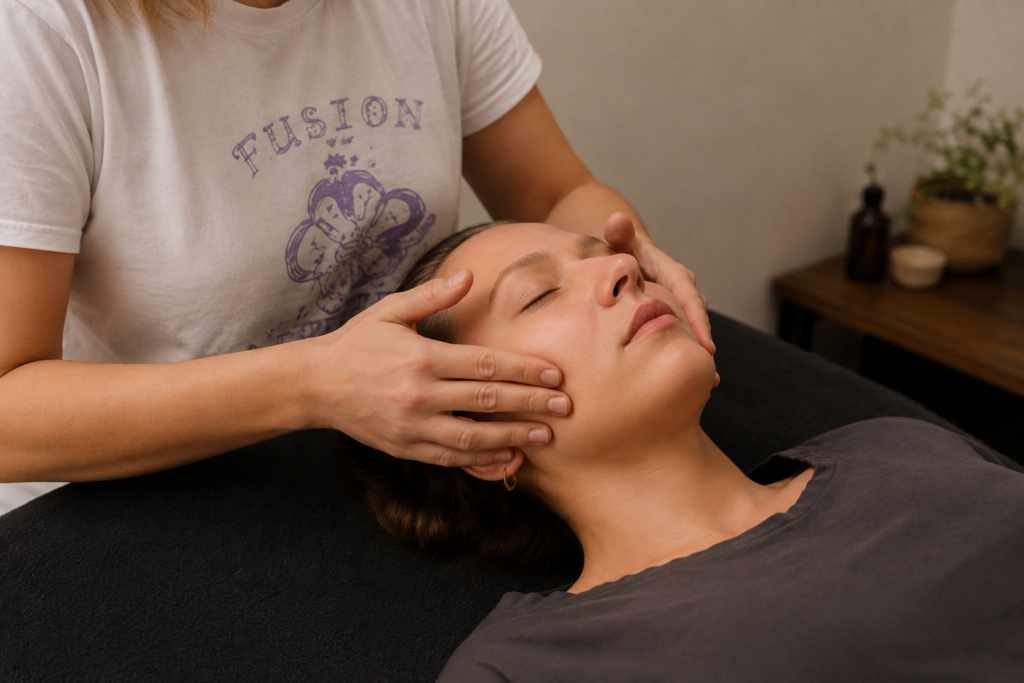
Kobido is a Japanese approach to facial massage characterised by a rich variety of techniques, rhythms and qualities of touch.
Today, it is often presented primarily as an “anti-ageing” or beauty treatment. And while appearance can certainly be part of the experience, there is another side of Kobido that I find at least as interesting.
The face is an incredibly active and sensitive part of the body. We use it to speak, eat, look, react, communicate and express ourselves — often without paying much attention to how it actually feels.
From this perspective, Kobido can be explored not only as facial care, but as bodywork for the face, head and neck.
What happens during a Kobido session?
The session follows a sequence of techniques that work with the face and surrounding areas.
The method I practise incorporates five different elements:
1. Deeper tissue work
Slower, more focused techniques work with the face, jaw, neck and head, using kneading, compression and sustained pressure. This part of the massage allows more time and attention for areas that may feel tense or tight. “Deep” does not mean painful — the intensity varies depending on the area and stays within a comfortable range.
2. Relaxation
The pace slows and the movements become softer, smoother and more repetitive. Gentle strokes and rhythmic movements across the face, head and neck create a quieter contrast to the more active parts of the massage and allow time to settle into the experience.
3. Drainage
This stage uses movements following pathways commonly used in facial lymphatic drainage. The movements work across the face and towards the neck, following the direction of lymphatic flow.
4. Lifting techniques
Here the rhythm becomes faster and more dynamic. A combination of quick kneading, rolling, percussion and other manual techniques moves and stimulates the soft tissues of the face. This lively, technically precise stage is one of the most characteristic parts of Kobido and is traditionally associated with its cosmetic dimension.
5. Acupressure
Focused pressure is applied to specific points on the face and head, using fingers or thumbs and holding each point briefly. This part of the sequence comes from the traditional framework of the practice and provides another change of pace and sensation within the massage.
Together, these create a massage with continually changing rhythm, pressure and intensity rather than a repetitive sequence.
What does the research actually say?
Scientific research specifically on Kobido is still limited. There is more research on facial massage and massage therapy generally, which can provide useful context but shouldn’t automatically be treated as evidence of Kobido-specific effects.
- Facial massage, mood and anxiety
A 2008 study examined 32 healthy women before and after a 45-minute facial massage. Immediately afterwards, participants had lower scores for anxiety and negative mood. The researchers also observed a change in one measure of autonomic nervous-system activity.
Hatayama et al., 2008 — PubMed
- Research involving Kobido techniques
Kobido facial massage may improve facial appearance by reducing muscle tension, smoothing skin folds, and improving facial contours. It may also enhance blood and lymphatic circulation in the face and head.
Leszczyńska & Zaleski, 2024 — Full article
- Facial massage and blood flow
A 2018 study found that a short facial massage with a roller temporarily increases blood flow to the skin. Using a facial roller regularly over a longer period may also help the blood vessels widen more easily, improving circulation.
- Massage and physiological measures associated with stress
Massage therapy can temporarily reduce physiological signs of stress, particularly cortisol levels and heart rate after a single session.
Moraska et al., 2010 — Full review on PMC
- Facial massage and ageing
Research and early findings suggest that regular physical activity and manual lymphatic drainage may help prevent skin aging by safely supporting the skin’s structure and healthy function.
Nowakowska et al., 2025 — Full review
Beyond appearance
For me, this makes Kobido part of a broader exploration of the body through touch and attention. The face may look different afterwards. You may or may not notice that.
But perhaps there is another question worth asking alongside: “How does my face look?”, “How does my face — and the rest of me — feel?” That is the perspective from which I practise Kobido.
Curious? Contact: atworkagnieszka( @ )gmail.com