Practice with deep roots
Thai Yoga Massage is part of Thailand’s traditional system of medicine and has been practiced for centuries. In 2019, UNESCO recognized Traditional Thai Massage as an Intangible Cultural Heritage of Humanity, acknowledging its cultural significance and the way knowledge has been passed down through families, communities, educational institutions, and healthcare traditions.
Traditionally, Thai massage is viewed as a holistic approach to supporting wellbeing, combining physical techniques with principles from traditional Thai medicine and an emphasis on balance in the body.
What happens during a Thai Yoga Massage?
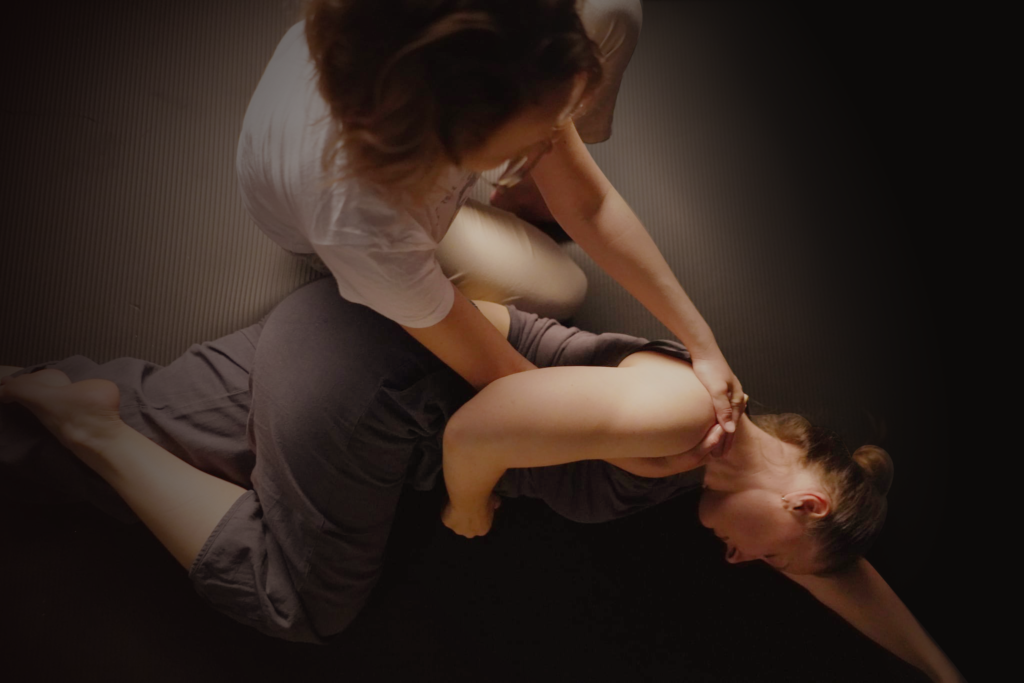
Unlike many forms of table massage, Thai Yoga Massage is typically performed on a comfortable floor mat, with the client fully clothed. The practitioner guides you through a series of movements while using hands, thumbs, elbows, forearms, and sometimes feet to apply pressure and assist with stretching.
A typical session may include:
- Assisted stretching
- Rhythmic compression
- Joint mobilization
- Gentle rocking or movement transitions
What’s interesting here is that the work is not only about pressure on soft tissue, but also about how the body is moved through space. Many of the effects people report—relaxation, release, or increased mobility—likely come from a combination of mechanical input, nervous system response, and the experience of being guided through structured movement.
More than physical techniques
Thai massage is traditionally practiced with an emphasis on attentiveness, care, and respect. Many schools teach the principles of metta (loving-kindness) and karuna (compassion), values influenced by Buddhist traditions in Thailand.
From a modern perspective, this is where things get interesting: research increasingly suggests that the “how” of touch matters almost as much as the “what.” In other words, the same physical technique can land very differently depending on attention, pacing, and the practitioner’s presence. So yes—there is technique, but there is also a kind of relational quality that is harder to measure but very easy to notice when it’s missing.
Empirical evidence
Research on Thai Yoga Massage is still developing, but there is a growing body of studies suggesting potential benefits, particularly in relation to pain, stress, and relaxation responses. As with many manual therapies, results vary depending on protocol, population, and how outcomes are measured.
If you’re a bit of a nerd about the science of relaxation like I am, you might enjoy digging into some of the research below:
- A large 2024 systematic review and multivariate meta-analysis of over 130 studies found that touch-based interventions, including massage and other structured forms of therapeutic touch, are associated with measurable benefits for both mental and physical well-being (Packheiser et al., 2024). The strongest and most consistent effects were reductions in pain, anxiety, and depressive symptoms across a wide range of populations and settings. Evidence also suggests that therapeutic touch may help lower physiological stress markers, including cortisol, although results vary depending on context and method. These benefits were observed in both clinical care and everyday wellness settings, highlighting the broad relevance of touch for human health.These findings support the growing evidence that structured, consensual touch therapies like Thai massage may help support both body and mind.
- Chompoopan et al. (2024) conducted a randomized controlled trial examining traditional Thai massage as an adjunctive therapy in patients with major depressive disorder who were receiving antidepressant medication. The study found that participants receiving Thai massage showed a statistically significant reduction in depression severity scores compared to the control group, along with improvements in quality of life measures. Secondary outcomes also indicated reductions in blood pressure and improvements in perceived wellbeing.
- Sripongngam et al. (2015) investigated the immediate effects of Traditional Thai Massage on stress in healthy adults. Participants received either a one-hour Thai massage session or a period of rest following a stress-inducing task. The researchers found that Thai massage was associated with a greater reduction in a biological marker linked to stress compared to rest alone. The findings suggest that Thai massage may help support relaxation and the body’s natural stress-regulation processes.
- Peungsuwan et al. (2014) reported improvements in pain, walking ability, and quality of life among older adults with knee osteoarthritis following interventions combining Thai massage and exercise.
- Similarly, Chiranthanut et al. (2014) found that Thai massage combined with herbal compress therapy produced outcomes comparable to oral ibuprofen in individuals with knee osteoarthritis over a short-term intervention period.
- In addition to these individual clinical trials, a broader evidence base has been synthesized in systematic reviews. Keeratitanont et al. (2015), in a systematic review published in Complementary Therapies in Clinical Practice, examined controlled trials on traditional Thai massage for chronic pain. Across six included studies, the authors reported consistent pre- to post-treatment reductions in pain intensity ranging from approximately 25% to 80%. Improvements were also observed in related domains such as muscle tension, flexibility, anxiety, disability, and treatment satisfaction. Some studies included in the review also suggested potential physiological effects, including changes in heart rate variability, EEG patterns, and biochemical markers associated with pain perception.
Thai massage in the modern world
Today, practitioners often draw on both traditional Thai methods and contemporary understanding of anatomy, movement, and manual therapy. While the cultural roots remain important, many modern practitioners integrate insights from physiotherapy, myofascial work, oseopathy, yoga, and movement education.
Although techniques are important, many modern practitioners view the quality of attention, communication, and therapeutic presence as equally significant. The traditional values of metta (loving-kindness) and karuna (compassion) continue to influence contemporary training and practice, not as religious requirements, but as qualities that support respectful, attentive, client-centered care.
A movement-based approach to bodywork
One of the features that distinguishes Thai Yoga Massage from many Western massage styles is its emphasis on movement. Rather than focusing only on isolated muscle work, the practitioner uses assisted stretching, joint mobilization, guided positioning, and rhythmic compression to work with the body as a connected system.
As a result, many people experience Thai massage less as something being “done to them,” and more as a guided process of movement and release—somewhere between bodywork, assisted stretching, and the slightly rare experience of being manually convinced to relax.
Curious? Contact: atworkagnieszka( @ )gmail.com